Wednesday, September 7, 2022

What is a paleo-left agenda?

When I recently had a discussion with Alex Hochuli and Philip Cunliffe at their podcast (you can listen to it here), they mentioned one of my pieces on what I called the paleo-left. In the podcast, I went over the main features of the paleo-left, and I think that it may be useful to put them down again in writing. And hopefully to show that they can be readily made into actionable policies and are not just a set of nice words strung together.

The paleo-left agenda, in my opinion, has four key planks: it is pro-growth, pro-equality, for freedom of speech and association, and for international equality. Let me explain each.

Being in favor of growth means that the paleo-left acknowledges that income and wealth are indispensable conditions for human self-realization and freedom. We cannot achieve our potential, nor enjoy other non-pecuniary activities unless we have enough income not to worry where the next meal comes from or where we are going to sleep the next night. The paleo-left is against the constant denigration of growth because it recognizes that for an ordinary person improved material conditions of living open the “realm  of freedom”: we do not want households where mothers have to wash clothes in the nearby creek or in the bathtub; we want households with washing machines. (Of course, for people who already own washing machines this might seem like a trivial demand. But for half the world that does not it is not trivial at all.)

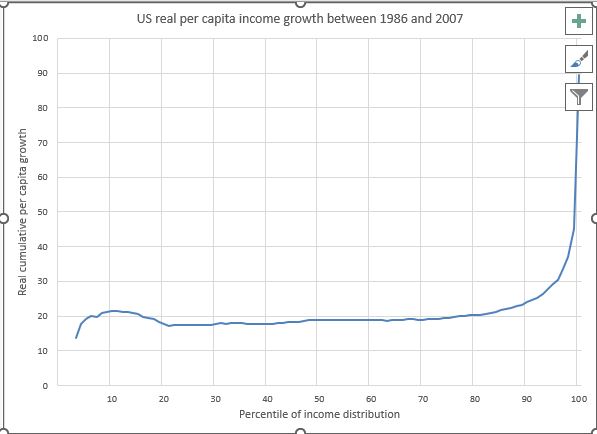
Growth as such without taking into account who benefits from it is neither ethically acceptable, nor politically sustainable. That’s where the second plank comes in: economic equality. Growth cannot be blind, nor can it be such that most of it, like in the US in the period 1986-2007 (see the graph below) is collected by the rich. It must be pro-poor which means that incomes of the lower groups should rise, in percentage terms, at least as much as incomes of the richer groups. How to achieve this? Not only through direct taxation or indirect taxation of activities and goods consumed by the rich (the latter is an area which is, in my opinion, under-utilized). It can be achieved through high inheritance taxes which would ensure reasonably equal starting position regardless of parental wealth, by almost free or fully free public education and health, and by special support for the young, around the time of their first jobs. The young are now in the developed Western societies as a group in need of as much support as what people who are currently old managed to politically achieve in the 1960s and 1970s. 


Reduced income and wealth inequalities are both an objective in themselves and a tool for achieving something else: relative political equality. That equality is undermined in today’s advanced societies not, as it is claimed, by an ill-defined “populism”, but by a very opposite danger: that of plutocracy. The fact that rich people fund the campaigns, pay politicians (which is just a more subtle form of bribery), and control most of the mainstream media, makes mockery of political  equality.

The paleo-left should, in my view, eschew such terms that the neoliberal discourse has captured and made meaningless, like democracy. We have to acknowledge that the term “democracy” has been hijacked by the neoliberal plutocracy in the same way that the term “people” was hijacked by the communist authorities in Eastern Europe. Both terms are used to cover up the reality. 

Instead the paleo-left should focus on something much more real and measurable: approximate political equality. The latter implies public financing of political campaigns, limits (or bans) on rich people’s control of the mass media (no “Washington Post” ownership for Jeff Bezos), and equal participation in the electoral process which in turn means making participation in the elections easier for hard-working people. Current elections in the US are intentionally scheduled for a working day, and it is neither a surprise, not an advertisement for “democracy”, that even in the most important elections one-half of the electorate simply does not participate.

The paleo-left also recognizes that the freedoms of speech and association are largely meaningless so long as approximate political equality does not exist. Individuals can spend hours and days complaining on Twitter, but it will carry zero political influence as compared to the well-paid and organized think-tanks and other institutions whose objective is to directly affect policy. It is in that area that a vague use of the term “democracy” in reality conceals vast inequality in access to political power.

The last plank is internationalism. This is, of course, an old left-wing slogan, and it should not be seen as something that is just tacked on to the rest of the domestic agenda. It is a constituent part of the overall agenda. The paleo-left accepts that different countries and cultures may have different ways in which they choose their governments or in which they define political legitimacy. The paleo-left is not ideologically hegemonic. The paleo-left might believe (and should believe) that its own approach is the best, and is right to argue for it, but the argument must be always at the level of ideas, must avoid gross interferences in the internal affairs of other countries, and must obviously never use violence. The paleo-left must get rid of the noxious idea of a “liberal world order” which is either meaningless (as it changes depending on what is politically convenient for its proponents) or is an outright invitation to wage wars. It replaces it by the respect of international law as defined by the United Nations, and by other institutions that are inclusive of all peoples. The paleo-left proselytism is made only by non-violent means, and with respect for other cultures and states, and no coercion of any kind.  

There are many other issues that cannot be directly covered by these simple rules. They concern migration, gender and racial equality, relations between the church and state etc. but they can be, I believe, relatively easily deduced from these four general principles.

Wednesday, August 31, 2022

A politician who did not want to rule

            God has not been kind to Mikhail Gorbachev to not allow him to die before February 24, 2022 and not witness the senseless destruction of everything he stood for. And perhaps even to reflect how sometime the decision not to use force may later lead to a much greater carnage. If Mikhail Gorbachev had maintained the Soviet Union (perhaps without the Baltics), and used the force the way that Deng Xiaoping did, we might not be now looking at a senseless internecine war that has already claimed  dozens if not hundreds of thousands of lives, and which in the worst case might degenerate into a nuclear holocaust. Politicians, even those who are the most humane, must unfortunately make this calculation where human lives are just numbers.

            Gorbachev refused to do so. Perhaps to openly state that was a mistake: nobody was any longer taking him seriously, from Baku to Washington,  although he sat atop of the largest nuclear arsenal in the world, the second largest military in the world, hundreds of thousands of police and domestic security forces, and as the Secretary General of the monopolistic party disposed of unquestionable loyalty of 20 million of its members.

            By the standards of statecraft, he must be judged harshly, like one of the most extraordinary failures in history. By the standards of humanity, he must be judged much more kindly: he allowed millions to regain freedom, not only proclaimed, but stuck to the principles of non-violence in domestic and foreign affairs, and left his office willingly, when he did not need to do so, simply because he did not want to risk lives in order to keep it. But being  nice and, in fact, anti-political, he left the field open to much worse men.

            He was incapable of running a complicated, fraught by too much history, multinational, and vast empire like the Soviet Union. The country was additionally “saddled” by its reluctant satellites, the unwinnable war in Afghanistan, arms race with a much stronger opponent, and a quasi-stagnant economy. The situation that Gorbachev inherited was far from easy. But, it was manageable, and the fact that nobody predicted the precipitous economic, military, and political decline of the Soviet Union confirms it. Gorbachev, by trying to improve things, made them catastrophic. Many people in retrospect, and perhaps out of respect for Gorbachev (which we do owe to him) tried to explain the descent into the chaos by claiming that the system was “unreformable” and that everything was preordained. The role of Gorbachev, the person, in that view of history is almost non-existent. But this is wrong. A more competent ruler, a savvier politician, a more ruthless man would have handled things differently, and might have forestalled the catastrophe.

            The most mysterious part is his rise to power. I do not mean it in a conspiratorial way because there was no conspiracy. The part that must puzzle everybody who reflects on it is the following: given how badly skilled Gorbachev was in handling the economy and politics at the central level, how come that these defects have not become apparent much earlier as he climbed the ladders of power? Didn’t anyone notice that in Stavropol? Moreover, given how willing he was to reject the rule of bureaucrats who brought him to power and who worked with him for several decades, how is it that they have not seen the red danger lights flashing behind that man with the affable smile? How is it that Andropov, not a person who displayed a huge sense of humanity, nor who, by his job description, could have been fooled easily, did not see the fault-lines in Gorbachev that, once in power, would blow up the entire Empire?

            I do not think that there will ever be a good answer to that, especially not because Gorbachev did not conceal his opinions nor pretend to be different person from what he was. The only way to understand how a powerful bureaucracy would let somebody who is going to destroy it climb to power within that same bureaucracy is to believe that Gorbachev’s own views had evolved over time. That when he started reforming the system his view were very much within the acceptable reformist camp, of which even Andropov approved, but that as each step of reforms proceeded, his views evolved in direction of greater freedom, so that at the end he was presiding over a party that was an amalgam of incompatible factions and tendencies, from KGB stalwarts (Kryuchkov), to anti-reformists (Ligachev), to red directors (Chernomyrdin), to corrupt thieves (many Komsomol leaders), to technocrats (Gaidar), to social democrats (Roy and Zhores Medvedev).  

             Can we draw some conclusions? Regarding politics, we would need a person of Machiavelli’s caliber to describe what happened and why. But for Russian politics of succession, the lesson seems clearer: Stalin could not have imagined that somebody like Khrushchev (whom he treated like a not very smart country bumpkin) could ever succeed him; neither could have Khrushchev imagined that the “beau Leonid” would engineer an internal coup against him;  Andropov made a misjudgment on Gorbachev, who in turn underestimated Yeltsin. Yeltsin picked Putin to do one job, but received something entirely different. It is unlikely that Putin alone would not commit the same error.

Sunday, August 21, 2022

Why was the Soviet Union created?

            When Putin in his ideological salvo that preceded the actual war in Ukraine placed the blame for the existence of the Ukraine within its current borders on Lenin, Stalin and Khrushchev, he not only opened up the Pandora’s box of borders,  but led to the renewed discussion of the creation of the Union of Soviet Socialist Republics in December 1922. (Putin’s blaming of the three Soviet leaders was as following: Lenin for ignoring the Russian majority population in the Donbass and thus “giving” the Donbass to Ukraine; Stalin for “giving” the eastern part of Poland after World War II to Ukraine, and Khrushchev who “for whatever reasons” decided in 1954 to transfer the Crimea to the Ukraine.)

            There is often very little understanding among many, especially young, people about the ideology behind the creation of the Soviet Union. In an otherwise good article recently published in the “National Interest”, Mark Katz rejects Putin’s critique of Lenin by arguing that “instead of blaming Lenin, Putin should draw lessons from Lenin’s realization that a more accommodative approach toward Ukrainian nationalism would better serve Russia’s long-term interests”.

            This point however shows  marked lack of understanding by Katz of the forces that led to the creation of the Soviet Union, in addition to imputing Lenin to have been concerned with “Russia’s [sic!] long-term interest”—a statement that only people unfamiliar with Lenin’s ideology and writings could make. But let us go back to the creation of the Soviet Union. The most important person behind the  creation of the Union was Stalin, not Lenin. Stalin, as is well known was the People’s Commissar for Nationalities,  and was, within the Bolshevik leadership the person in charge of nationality questions, including obviously the creation of a new Union composed of ethnically-based republics. (At the creation there were six republics: RSFSR, Ukraine, Belorussia, and the Transcaucasian Federation  composed of Georgia, Armenia and Azerbaijan.)  Here is what Stalin said about the creation of the Union:

Finally, there is a third group of facts, which also call for union and which are associated with the structure of the Soviet regime, with the class nature of the Soviet regime. The Soviet regime is so constructed that, being international in its intrinsic nature, it in every way fosters the idea of union among the masses and itself impels them to take the path of union. Whereas capital, private property and exploitation disunite people, split them into mutually hostile camps, examples of which are provided by Great Britain, France and even small multi-national states like Poland and Yugoslavia with their irreconcilable internal national contradictions which corrode the very foundations of these states— whereas, I say, over there, in the West, where capitalist democracy reigns and where the states are based on private property, the very basis of the state fosters national bickering, conflicts and struggle, here, in the world of Soviets, where the regime is based not on capital but on labour, where the regime is based not on private property, but on collective property, where the regime is based not on the exploitation of man by man, but on the struggle against such exploitation, here, on the contrary, the very nature of the regime fosters among the laboring masses a natural striving towards union in a single socialist family. (my emphasis)

Very similar statements are repeated in several publications, speeches and interviews that Stalin gave at that time. The links are here and I would suggest that people read at least some of them. For my purpose here, the key thing to understand is that the ideology behind the creation of the Union was not whether that Union, with the Ukraine defined one way or another, would be more or less stable at Katz implies, but that the Union is simply the reflection of the end of national and class contradictions that come with the socialist revolution. It is thus a “natural” striving  of peoples liberated from under the rule of capital, and –the most important point—it is therefore is open for all other parts of the world that, sooner or later, may also become free. The USSR was thus created not as a finished state, but as an open-ended state that would grow as socialism spreads to the extent of including within it all European, and perhaps even all countries in the world.

To make this union more attractive, the open-endedness was not only in accepting the new countries, but in allowing those that are included to leave. Thus “the character of the union should be voluntary, exclusively voluntary, and every national republic should retain the right to secede from the Union. Thus, the voluntary principle must be made the basis of the Treaty on the Formation of the Union of Soviet Socialist Republics”. Here the point is made by Stalin, but Lenin, as is well-known, insisted on that double open-endedness even more.

Consequently, it is not the political stability of what then constituted the USSR that was of paramount importance to its Bolshevik founding fathers but its openness. This is a point on which Lenin, Trotsky, Stalin and the entire leadership were in full agreement. The new federated Soviet Union was not the end- formation, but the beginning-formation. The Bolsheviks expected the success of the revolution in Germany, Austria and Hungary any time. Thus they expected that these new Soviet republics (as they indeed called themselves) would soon join them in a federated state even if they were for now defeated. It is notable that the USSR has no geographical denomination in its name. When the United States of America were created (in  a somewhat similar fashion like the USSR) the founding fathers did include a geographical limit in its name. Not so the Union of Soviet Socialist Republics.

   It is then fully understandable that Mao Zedong proposed in 1949 to Stalin that China join the USSR (Stalin, after some reflection, rejected the idea). It was a “normal” view entertained by many communists world-wide. When the communist revolution won in Yugoslavia, many people there thought that the next step would be the accession to the Soviet Union. I recall my father’s friends in 1960s in their conversations talking of believing in the 1940s that Yugoslavia would immediately apply to become another republic of the USSR. 

Perhaps for today’s generations that know very little about the communist ideology and the forces that led to the creation of the USSR, this may be difficult to grasp, but it would help to think by analogy: if instead of the USSR they think of the European Union. The EU is a similar supra-national and ideological creation, and it is at present thought “natural” in many parts of Europe to believe that countries will ultimately “accede” to that Union. It was likewise thought “natural” among the communists that, as individual countries became free, they would “accede” to the Soviet Union.

One can think of at least two other historical precedents when ideological homogeneity was thought sufficient to trump over all other allegiances including national. The first precedent is the Christian empire that was thought  indissoluble and one. The emperor in Constantinople was thus shocked when the Pope decided to bestow the crown on Charlemagne and create yet the second Christian emperor. It was thought inconceivable that Christians would have two different empires since they were all just that: Christians. Another example is Islam where too, at the origin, it was believed that all Muslims, anywhere in the world, would be united into a single political union, the khalifate. That too rather quickly evaporated. But as in the case of communism and the Soviet Union, it is important to understand the ideological motives of the founders and not to ascribe to them the goals that seem reasonable to us now, but that they simply did not have at the time.