Sunday, January 9, 2022

Trotsky on the class structure of Soviet socialism

For the reasons that are too complicated to explain here (and perhaps also because you can read about them in my forthcoming book on how income inequality was studied from Quesnay to the fall of the  Berlin Wall), I reread some of the literature that looks at the class structure of socialist societies. Most of that literature is obviously Marxist or close to Marxism because anti-Marxists were busier showing that capitalist societies were not class-based than arguing that socialist societies were class societies.

            I found particularly useful the work of Branko Horvat (whom I had the  privilege of knowing personally) who had argued about the class character of state socialism from his early work in the 1960s. Moreover, Horvat did this using data on incomes, position in the process of production, transmission of advantages across the generations etc.—i.e. on the factual basis and not merely as definitions or tautologies. Szelényi and Konrad were also useful even if their approach is slightly different. And then very much so, the surveys of class perceptions/divisions that were carried out by sociological institutes in Yugoslavia, Poland, the Soviet Union (in the 1960s), and probably in Hungary (although I have not found the data).

            But among the very early writers who argued that state socialism is, or comes close to, a class society Trotsky obviously stands out. He was not among the very first, because when the first, like Pannekoek and Labriola, appeared, Trotsky was actually in power. (One should not forget that Emma Goldman also described well many class features of early socialism.)

            So I read again Trotsky’ classic “The revolution betrayed”. I wrote recently about the very negative view that Kolakowski had of Trotsky. I find that view largely justified (on the topics Kolakowski criticized Trotsky), but there is no denying manifold qualities of Trotsky as intellectual, writer, organizer and military leader. It was his arrogance and hubris that did him in, but that’s a different topic. So, how does Trotsky approach the Stalinist state in “The Revolution Betrayed”?

            His main argument is quite persuasive. First, he believes that the Soviet state is a proletarian state because private ownership of  means of production has been abolished. Second, he believes that it is a state where bureaucracy has built itself into a new stratum that has vitiated the original (“democratic”) objectives of the revolution in its superstructure (politics), but has not fundamentally managed to alter the infrastructure (that is, property has not been returned to private owners). It is (as he writes) like Caesarism that changed politics in Rome but did not affect the underlying slave-owning relations of production, or the Thermidorian reaction in France that undid the Revolution politically, but did not erase economic gains (e.g. distribution of land to small-holders).

            This view leads Trotsky to two positions. First, in some parts of the book he extols the achievements of “Stalinist Thermidor” hardly less than the Soviet press of the time. He reels off with pride enormous increases in industrial output, multiple new combinates that have been built etc. He does mention lack of workers’ freedom (no free trade unions) and that most of the technology was imported. Trotsky, like Lenin, is a modernizer who sees Russia as economically backward, but thanks to its having become socialist being in the process of the catch-up with the West. So, he regards the new system as self-evidently more productive than the old.

            Second, he calls only for the revolution in politics, not in economics. The new revolution, Trotsky writes, must be very different from the October revolution that overthrew the very bases on which the society was built. The new revolution needs only to overthrow the new ruling stratum (Trotsky avoid the term “class” because he believes that the term should be reserved for societies with private ownership of capital), and to reestablish the original pristine character of the revolution.

            There are many problems with this view. For example, Trotsky’s present acceptance of free trade unions (for whose abolishment he argued when in power), and of the multi-party system which he also helped abolish, including all the left-wing parties, not to mention that he directed the pitiless military assaults on anarchists and on Kronstadt rebels. Even more naïve is his view that such parties, when the hypothetical Leninist-Bolsheviks (i.e. Trotskyists), return to power would not play any substantial political role because the basis of their power (private ownership of capital) has been forever withdrawn from them. Thus he has an extremely reductionist view of politics where politics is entirely determined by economic interests. Once there are no large landholdings and private companies, there is no longer any basis for conservative or right-wing political parties. Such parties might perhaps garner 1 or 2 percent of the vote (this is why Trotsky would allow them to exist), but they are, by the nature of things, always to stay marginal and irrelevant.

            On Stalinist workers’ policies, Trotsky is remarkably inconsistent. On the one hand, he brilliantly exposes how little power many workers have. He even discusses the reasons why the quality of Soviet products is the worst for the products of mass consumption and the best for the products where the State is the ultimate purchaser like the armaments whose Stalinist developments he discusses with some unconcealed pride and, I presume, with quite a lot of knowledge. This was the first such analysis where the quality of workmanship is related to the power of those who consume it, and thus in itself helps us gain insight into the relations of power which exist in a society. It is, I think, brilliant. (The workmanship used in a Michelin star restaurants exceeds many times the workmanship used in McDonalds’  franchises  because the patrons of the former do have political and economic power—and would sue the hell out of a Michelin star restaurant's owner if he food-poisoned them while the buyers of big Macs cannot complain much—nor would anyone care if they did.)  

            But, on the other hand, he criticizes material incentives paid to stimulate harder work even if in an unrelated sentence he acknowledges that too much of leveling during the War Communism had destructive effects on economic productivity. He reserves his animus for Stakhanovist workers who, Trotsky holds, have become a new workers’ aristocracy. He lists high salaries they receive, numerous benefits in kind (vacation, top sanatoria), and in some cases even automobiles. He probably righty sees them as the base of support for Stalin amongst workers. But Trotsky’s view that one could increase production without providing material incentives is unfortunately wrong. He also fails to recognize a strong element of upward mobility which Stakhanovism allows to a part of the working class: where else could –according to Trotsky’s own examples—a worker expect to have a higher standard of living than the director of a company, or a former owner? In a nod to what would become a standard practice during the Cultural Revolution in China, Trotsky singles out for praise Stakhanovists who were (allegedly) embarrassed by the showering of such privileges. They worked simply out of necessity (pleasure) that, in a society without exploitation of labor, labor acquires for free men and women. For them, work was totally devoid of disutility; it was simply a free expression of one’s desire to do things well and is not stimulated by material incentives.

            It is noticeable that Trotsky does not admire such work on the grounds of selfless dedication to socialism but rather, following Marx, believes that in a non-class-based society work will become the expression of our desire to do things well, that the homo faber has the need for self-realization in his work, and that that need can be expressed freely only when he is not a hired labored ordered around by capitalists.

            These are only some of the insights provided by this small volume. I did not discuss Trotsky’s well-known attacks on the ways of life of the new Stalinist stratum, their access to domestic help and chauffeur-driven cars, nor his equally well-known acerbic attacks on the political police, torture of the Old Bolsheviks, concentration camps etc. He uses (several times) the term “totalitarian.” There is also a most interesting discussion of foreign affairs, the rise of Fascism, the wrong-headedness of Stalin’s policies of conciliation with England and France, and abandonment of pro-proletarian policies in favor of pro-bourgeois foreign stance.  May I also mention that Trotsky even discusses what would happen if the Stalinist system evolved toward reintroduction of private property and allowed for  “denationalization” spearheaded—he writes incredibly presciently—by the new Stalinist stratum and by foreign capitalists.  Writing of that in 1936, that is sixty years before “loans for shares” happened, is not a small feat. But this may be a topic for another post.



Friday, December 31, 2021

What I read in the Year III of covid: an annotated summary

 I will try to imitate my colleague @milescorak who nicely summarized his work and readings in 2021.

Most of my work was on my forthcoming book “Through the lens of inequality” that looks at how inequality was perceived and framed (popular word these days) from before the French Revolution to the fall of the Berlin Wall.

The book covers Quesnay, Adam Smith, Ricardo, Marx, Pareto and Kuznets. And then the last chapter looks at inequality studies in communist and capitalist countries between 1960 and 1990.

The most challenging chapters are the last one (why the eclipse of inequality studies?) and the one on Marx. Marx is always a challenge both because of the breadth of his writings and combination of philosophy, history, literature and economics in them; as well as tons of commentary it produced during the past 150 years.  

So, in terms of this year’s readings, let me start with the Marxiana.

I re-read all three volumes of Leszek Kolakowski’s “Main currents of Marxism” that I read 30 years ago. Absolutely brilliant. Kolakowski’s erudition is breathtaking. You wonder: Oh, why I cannot know as much as he does?

He also has the advantage of having lived in Moscow in the 1950s and speaking Russian, so he covers Russian (often Stalinist) authors who are almost unknown in the West.

The towering presence in the books is Lukacs’s. Although Kolakowski is critical of him (“intellect in the service of a dogma”), there is no doubt that Lukacs’s influence on Kolakowski was enormous. (He says it himself in the preface.) According to Kolakowski (and not only him), Lukacs was the most important Marxist philosopher of the last century. Gramsci also gets an “honorable mention” as does Sorel, and even Lenin for his “Philosophical Notebooks” (on Hegel) of whose existence I have totally forgotten.

Here is my Substack review of Kolakowski’s view of Trotsky. Not very flattering to say the least.

https://branko2f7.substack.com/p/trotsky-after-kolakowski

This Fall I read Shlomo Avineri’s “The Social and Political Thought of  Karl Marx.” It is a beautiful book that tries to present Marx as a West European liberal thinker. I think that Avineri downplays the revolutionary character of Marx especially in the context of 1848-51 and the Paris Commune. Marx can never be seen as a liberal *only*. Perhaps liberal too--in some ways--but surely not as *only*. Avineri,  unjustifiably I think, takes a super critical attitude towards Engels who is accused of misinterpreting Marx. I wish I had reviewed the book—perhaps another time.

I have to say that neither Kolakowski nor Avineri have directly influenced my Marx chapter—simply because they do not discuss much Marx’s economics. But indirectly they are absolutely invaluable. Reading them, and also Marx's "Economic and philosophic manuscripts of 1844" (which I read for the first time this year too) made me realize how important is Hegel for understanding Marx as a philosopher. Unfortunately, I have not read any of Hegel, and even more unfortunately, I do not think I will start now.

S S Prawer has written a delightful book on Marx’s use of literature in his writings going over Marx’s classical education, his love for Greek writers and philosophers  (Marx’s dissertation was on Epicurus) and nothing less than adoration of Shakespeare, Dante, Balzac and Goethe. Marx largely learned English from reading Shakespeare whom he would cite in extenso to his children. In the last ten years of his life Marx also learned Russian so that he could read Russian authors in the original. I would recommend the book to all lovers of literature.

Finally, one disappointing piece of Marxiana were Benedetto Croce’s debates with Labriola (and Pareto) on Marx’s theory of value, marginalism, individualism etc. I did not like Croce’s style that is full of rhetorical questions (on a few pages I circled all the ?; they would run into a dozen), easy metaphors, sentences that seem often to be both simple and too complicated. I never finished the book.  

Adam Smith is (obviously) one of the six economists in my forthcoming book. I wrote the chapter on Smith the year before, so this year I read only Dennis Rasmussen’s “The infidel and the professor” (published in 2018), a story of the friendship between David Hume and Adam Smith. I reviewed it here.

https://branko2f7.substack.com/p/through-the-glass-darkly

A  very nice and light book.  I was interested in the relationship between Smith and the physiocrats but the book barely mentions it. There is apparently no new information on it.  

My interest in China continued unabated this year.

A monumental history of the Cultural Revolution was published in English in 2021. I reviewed Yang Jisheng book in two separate reviews, one critical, another laudatory (see below).  

https://brankomilanovic.substack.com/p/the-world-turned-upside-downa-critical

and

https://brankomilanovic.substack.com/p/license-to-kill-the-world-turned

There is nothing I need to add now to these reviews: the book is enormous, extremely well-researched, and for me it was a trip down the memory lane as I do remember many of the events from the 1970s: Chu Enlai’s death, Mao’s death, Hua Guofeng (whom I saw, from distance, live when he visited Belgrade in the late 1970s), the Gang of Four,  the “capitalist roader” Deng….

Isabella Weber’s “How China escaped the shock therapy” justifiably attracted huge attention. I participated in one of her book talks. I discuss the shock therapy and indebtedness of Eastern Europe (the themes addressed by Weber in the Chinese context) in this post.

https://branko2f7.substack.com/p/how-china-escaped-and-eastern-europe

I also read Julia Lovell’s “Maoism: AGlobal History.” It is a good book, fun to read, but with a somewhat exaggerated, or overdone, thesis of  Maoism as a global movement. Still you learn a lot about Abimael Guzman of the Sendero Luminoso notoriety (perhaps the best chapter of the book), the Khmer Rouge, the Sino-Soviet split, Enver Hoxha etc. I reviewed the book here:

https://glineq.blogspot.com/2021/05/a-global-ideology-that-was-neither.html

I enjoyed Stephen Pratt’s “Imperial Twilight” which describes how Britain ended up waging a war (the first Opium War) against China. My son recommended the book and I read it on the beach this Summer. Thus this year's Summer’s vacation will forever remain linked in my memory with this book. (For some reason, my Summer book choices always turned well.)  The Opium War was just the beginning of “the century of humiliation” but one does get the idea how China was mistreated by Western powers. I reviewed the book here.

https://branko2f7.substack.com/p/nobodys-war

Should I stop now? Let me just mention Anthea Roberts’ and Nicholas Lamp’s “Six faces of globalization” that takes off from the “elephant chart” to study how different narratives can be created around it. Quite a fascinating book especially at the time of Trump, middle class discontent in the West, and Sino-US conflict.

https://www.hup.harvard.edu/catalog.php?isbn=9780674245952&content=bios

I also read John Lewis Gaddis book on the Cold War. I knew that he was the premier  US historian of the Cold War and was curious  how, in this popularly written summary, he describes it. Gaddis is a very good writer, but the book is ultimately disappointing. Perhaps it is an unfair comparison but when you think how Thucydides was able to see the war from the point of view of different participants, you cannot but be disappointed to read Gaddis who sees it only from the Foggy Bottom and Pentagon perspectives. I felt a bit sorry for students whose sole exposure to the Cold War history might come from Gaddis.

This is about all that is worth mentioning.

I do not think that my reading priorities will change much in 2022. Will continue with China, Marx, Simon Kuznets (my author No. 6), inequality literature of the 1970s and 1980s (which is rather boring, so I did not review it here)….If a good book on World War I comes along by some chance…


Sunday, December 26, 2021

How I did not celebrate Christmas

 A week ago, a friend asked me how was Christmas when I was growing up in Yugoslavia, in the 1960s. I said to  her: “Christmas was cancelled.” That was true, but the full truth was a bit more complex. Like in the Soviet Union, but not in the rest of Eastern Europe, Christmas in Yugoslavia was combined with the New Year, and all the usual Christmas festivities, including the Christmas tree, Santa Claus and gift-exchange were just displaced by several days. Christmas was folded onto the New Year and lost most, or all, of its religious connotation. The official holiday was New Year’s day, a staunchly secular festivity.

How did that happen? When Communists came to power in Yugoslavia they faced a multi-religious country where different religions during the World War II, egged on by the Nazis, engaged into brutal internecine and religious wars. (Anyone who believes that religious people are tolerant knows nothing about history—or present, for that matter.)  In the intra-war Kingdom of Yugoslavia, both types of Christians celebrated their Christmases and Easters; they were official holidays, and it is possible (although I am not sure) that in the parts of the country with a Muslim majority some Muslim holidays were official holidays too. It was a complicated patchwork of religious celebrations. Yugoslav communists, dizzy with the success of the revolution, decided to cut the Gordian knot of religious celebrations  (which they disliked anyway) and get rid of all of them as official holidays.  

As I mentioned, they followed Soviet practice there. The situation was different in other Eastern European countries whose communists were more considerate, as they came to power mostly thanks to Soviet involvement, had to be a bit more thoughtful of the religious practices of the populace, and did not face a patchwork of religious holidays. Also, they often had to deal with a much more powerful Catholic Church. Thus, in Poland, Hungary, Czechoslovakia, Christmas remained celebrated, quite  openly.

I hardly knew about the existence of Christmas when I was a child. Both the 25th of December and the 7th of January were ordinary working days, with my parents, and everyone else's parents going to work. When I would read in the newspapers an article, for example, on how Parisian streets were especially nicely lit for that year’s Christmas, I felt vaguely that the French must have been celebrating some weird quasi-medieval festival that no modern-minded person would pay slightest attention to. For me, Christmas celebrations in Western Europe were a bit like those weird customs that I would read still existed amongst the British Lords, Queens and Kings that seemed so outlandish that I was wondering how an advanced country could have such unenlightened practices. It was perhaps like a feeling that votaries of some new religion might elicit among many people in the United States today.

In our elementary school, Christmas and Easter (of both kinds) were also ordinary working days. So far as I remember, nobody ever mentioned them. The only discordant note that I remember is that we had in our class a kid, Mikica by name, whose parents refused to send him to school on Christmas and Easter. He was a quiet, rather taciturn kid, nor much liked by other students, and twice a year, he would just not show up, get an unjustified absence from the teachers, but neither teachers nor anybody else made a big deal about it. For us, kids, it seemed that Mikica’s parents were somewhat unusual parents who instead of pushing their son to go to school, very uncharacteristically, forbid him to take classes on a specific day. In a way we liked it: not going to school and having parents on your side, seemed pretty cool.

Sociologically –and I became aware of that much later—there was an interesting angle to Mikica’s school absences. While most of my classmates’ parents worked for state-owned companies or government (including my parents), Mikica’s father belonged to the private sector. He was a taxi-driver. Somebody like my father, working for the government, could not, even if he wanted (and my father certainly did not—since he cheerfully ignored Christmas), celebrate Christmas or not send his kids to school on the Christmas day. The story of a communist party member and a government official taking a day off on Christmas or even hosting a Christmas dinner would spread. The outcome would be severe Party-cell critique, job demotion, and in the case of repeated offenses, probably firing.

But if one were in the private sector, the rules were different. My aunt, who was religious and cared about family traditions, would every winter organize splendid dinners, with white-table cloth and crystal glasses, either for Orthodox Christmas or patron saint (hers was St John on January 20). My parents, including my father, would gladly go there. The meals were exquisite, the wine good. But that was politically acceptable: going to a religious festivity hosted by a close cousin was not transgressing the rules. And my aunt, who was a dentist, having had private practice and then later (after the private practice for doctors was banned) working in a state-owned health system like NHS could freely celebrate Christmas. She was not member of the Communist Party and could do whatever she wanted with the exception perhaps of celebrating such holidays in too ostentatious manner. My other aunt who was a geography teacher did the same. Her position was more delicate because teachers were not supposed, by speech or deed, to engage in what might be considered religious propaganda. But she, deeply religious, observed all holidays quietly within the family.

And for us kids, as I said, Christmas was cancelled. We were looking forward to the New Year, when Father Frost would bring various presents, when we would decorate the tree, and as we grew older when we could go out, partying, drinking, smoking, and some even smoking illegal substances, until the wee hours of the morning.

The older we became, the more Christmas faded into irrelevance. The New Year’s eve with nice dinners, dancing parties and concerts was much more exciting. Where should I go? Private party, the new hotel, dancing floor? Who would come? How long will the party last? Excitement and impatience would overwhelm us in the last few days before December 31. And then as everyone was  getting ready for the party, and as I would shave in front of the mirror, to look fresh and neat, the scent of the new cologne would suddenly mix with the crisp and clean smell of the just-fallen snow---and with the dream of a girl I might meet that evening.


Tuesday, December 7, 2021

The Summit of Democracies is a wrong idea (for the world)

 More than 100 nations’ presidents, prime ministers and kings will virtually meet at the Summit of Democracies on December 9 and 10.  It is the first such meeting in history, where the application, or the ostensible application, of the democratic principles in the governance of national affairs is used as a criterion to invite the participants to an international meeting.

There are three ways to look at the summit. A naïve view is to consider it as a meeting of like-minded states interested in learning from each other about how to improve the application of democratic principles at home. (For that, however, there are  many other venues and there was no need to create a new one.) A more realistic way is to see it as an attempt to create a loose association of states that would try to promote abroad their model of governance under the assumption that it is compatible with the aspirational ideals embodied in the UN Charter of Human Rights. The most realistic way however is to see it as a  prelude to the creation of an unwieldy association of states that will be used by the United States to spearhead its ideological crusade in the escalating geopolitical conflict with China and Russia.

This is why the summit is, from a global or cosmopolitan perspective  (which it pretends to reflect), exactly the wrong idea. It aims to divide the world into two incompatible camps between whom there can be little intercourse and even less understanding. If things are taken to their logical conclusions, conflict is inevitable.

The clash between China and the United States is a clash driven by geopolitical considerations: the rising relative power of China and its attempt to reassert its historical prominence in East Asia. It has nothing with to do with democracy.

The clash has acquired an ideological dimension by the insistence of each side that its system is more attuned to the world’s needs. China puts the emphasis on its system’s technocratic nature which, it claims, efficiently responds to what people want; US puts the emphasis on democratic participation of the citizenry.

The geopolitical and ideological clashes however enter into a truly dangerous territory when they become transferred into the area of values. For geopolitical conflict can by solved, as has been done many times in history, by one or another formula of balance of power. The same is true regarding the economic or ideological competition of the two systems. It may be even beneficial to the world as each side, in trying to outbid the other, pays more attention to global issues such as poverty alleviation, migration, climate change, the pandemic and the like.   

But if one side believes that the values it incarnates are in total opposition to the values held by the other side, it is difficult to see how the conflict can, in the long-run, be avoided. Compromise between different interests is possible, but not between different values. The creation of an association which enshrines or cements the view of value-incompatibility between the American-type systems and the Chinese-type systems contributes to elevating the original clash of interests to a plane where compromise is near impossible.  

The formalization of the conflict forces all countries, whether they like it or not, to choose sides. Such alignment projects the US-China clash across the world and exacerbates it.

The lesson that we should have learned from the first Cold War is that the refusal to divide the world into two implacably opposed camp has diminished  the intensity of the conflict between the United States and the Soviet Union, and probably prevented a number of local wars. This was the contribution of the non-alignment movement. But this will be impossible now: there will be no third way. According to the logic of the Summit, you are either with us or against us. 

The Manichean logic of the struggle between good and evil pervades today’s attitude of many Western media and politicians. Many may truly believe that they are on the side of angels, or might have convinced themselves to believe so, but they do not realize that by doing so they participate in a very self-serving reading of history and bring the world closer to an open conflict. In fact, what they are doing is the very opposite of what peace-seeking, compromise-building, cosmopolitan approach would require them to do: seek common ground between systems and countries, and allow them to naturally evolve toward a better state of affairs.

All great conflicts begin with great ideological justifications. Crusades started with the idea of wresting the control of Jesus’ tomb  from the “the infidels.” They turned into plundering expeditions that destroyed all societies, Christian or Muslim, in their stead. European colonialism was justified in either religious (evangelization of the “heathens”) or civilizational terms. They were smoke-screens for the system of servile labor in Latin America, enslavement in Africa, and control of internal policies elsewhere (India, Egypt, China, and most of Africa). At the end of the First World War, a similarly megalomaniac project by Woodrow Wilson, while pretending to follow the great principles of self-determination  and democracy, degenerated into a rubber-stamping of colonial rule under the label of “protectorates” and “mandates”, and sordid territorial deals.   

This new grandiose project, if it remains alive, will end the same way: as a flimsy cover-up for much more mundane objectives. This is why the first summit of democracies should hopefully be its last.


Saturday, December 4, 2021

How to share vaccines between the poor and the rich

 Until a friend asked me yesterday, I have not given much thought to the vaccine gap between rich and poor countries. My “line of business” is global inequality; so I am inured to the fact that the gap in per capita incomes between rich and poor countries is huge, that the gap in their CO2 emissions per capita is similarly large, and I was neither surprised not did I pay much attention to the vaccine gap.

But his question led me to think a bit more carefully. And here is a small “model” that I think explains that gap. I apologize if somebody has already produced something similar or better. If not, I think that this small model, which can be made much better by the introduction of real data, may usefully be the basis of a nice paper.


How does the model work? First, assume that only rich countries produce vaccines; poor countries can buy them or are given vaccines. We’ll assume that they are given. Then,  suppose that all governments prefer to give vaccines to own citizens than to foreigners. This is, I think, obvious: citizens vote for the government and expect things from it, not foreigners. Third, introduce the externalities of the pandemic. The pandemic is not over until everybody is vaccinated and safe. (Yes, it could be over for the rich also if it remains endemic in some parts of the world, but given the level of infectiousness of covid, we can disregard this possibility.) So, let’s say that from each vaccine given to foreigners, rich country gets a small gain α: its own infections are reduced too if fewer people in poor countries get covid.


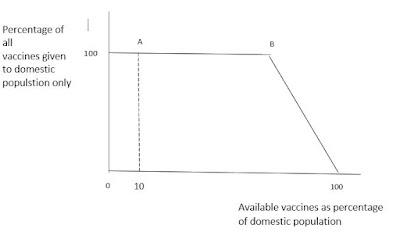
Now, after we have so nicely set up the assumptions, let rich country produce vaccines. At first the number of vaccines compared to total needs, that is, population in a rich country is small: you may have enough to vaccinate only 10% of the domestic population. At that point, domestic elements totally dominate. You give 100% of vaccines to the local population. This is our point A in the graph below. (The horizontal axis is the ratio between number of vaccines and domestic population; the vertical axis is the percentage of existing vaccines that the rich country will give to own citizens.) That situation will continue for a while: you will just provide vaccines to the domestic population. 


              But note that as we move toward 100% domestic coverage, the gain from additional domestic coverage may become less than α. Why? Because  the number of domestic infections may be reduced more by helping to control the spread of the disease elsewhere than by having an additional domestic citizen vaccinated. This happens at point B, and after that point, the rich country becomes willing to give vaccines to the poor. It thus seems that eventually all rich countries will, after vaccinating (say) 80% of their populations, reach the point at which the flow of vaccines to the poor world will begin. 


But is it true? We have not taken into account that the pandemic is not a one-shot (so to speak) event. There are new waves of the virus, and everyone requires additional booster shots. So even if at the end of the first wave, the rich country ended with almost 100% coverage of the domestic population and was thus willing to share vaccines with the poor world, the next wave will immediately push it back to the beginning, to our point A where it would have just enough for 10% of domestic population’s boosters. As the second wave progresses, the rich country will traverse exactly the same path as in the first wave, will again reach point B, might begin to share vaccines---only to be set back to the point A by the third wave.


Things get even worse afterwards. As we do not know how many waves there may be, it makes sense to build stocks of vaccines: it thus makes sense, as some rich countries have indeed done, to have 200% of vaccine/population ratio simply because one does not know how many waves (and booster shots) there may be. The conclusion is that incentives to share vaccines with poor countries are significantly diminished because the number of waves cannot be predicted. If we believe that we shall run through the entire Greek alphabet and more, then stockpiling vaccines is totally in the interest of the rich.


How can this be changed? There are, in my opinion, three possibilities. First, new waves might become more infectious. This, interestingly, will make α go up and rich counties more interested in sharing because they can be less isolated from the impact. Second, the world can be broken up into largely non-communicating regions. This  in turn reduces the advantage to the rich country of controlling the outbreak in a poor country and makes the sharing of vaccines less likely. If, for example, a country becomes totally isolated, it has no incentive to give vaccines to anyone. Finally, and by far the best option, is to increase the production of vaccines in poor countries. This ramps up the overall capacity and does not lead to rich countries having to make the invidious choice between domestic and foreign populations. They can give everything they produce to the domestic only so long as  poor countries can, and are allowed to, produce vaccines at home.  To do that however requires giving  up patent rights of vaccine-makers or compensating them (by the rich countries). It thus seems to me that unless we decentralize the production of vaccines, the gap will remain, and no amount of surplus in rich countries will lead them (rationally) to share vaccines with the poor.


Thursday, November 25, 2021

Through the glass, darkly: trying to figure out Adam Smith, the person

          Dennis Rasmussen’s book The infidel and the professor is a pleasure to read. It is an excellent introduction to the thinking and the friendship of David Hume (le bon David as he was dubbed by the philosophes during his wildly successful sojourn in France) and Adam Smith. I had a book recommended to me by a friend, and I read it with two objectives in mind: first, to get a bit more of a feeling for Adam Smith as a person, and second, to learn more about his relations with the physiocrats while he lived in France, On both accounts, I learned nothing. Still, the book was a pleasure to read: it is well structured, not overly technical, and very well written.

            Of the five economists I discuss in my forthcoming book (Quesnay, Smith, Ricardo, Marx, Pareto) I find Smith the most enigmatic. This book confirms him as being reserved, a somewhat distant and lonesome character despite dinners and company that he seemed to have, intermittently, enjoyed. Rasmussen’s thesis about the very close friendship between Hume and Smith is somewhat dubious, or is at least exaggerated. Rasmussen, for example, claims that it was the closest and/or the most important intellectual friendships in history. But just going over the five authors I mentioned, there are intellectual friendships that seem stronger: Quesnay and Mirabeau as well as Marx and Engels coauthored articles and books; Ricardo and Malthus, and Pareto and Pantaleoni corresponded much more frequently than Hume and Smith.

            So how close was the Hume-Smith friendship?  They did not spend almost any time living in the same place: when Smith was in Glasgow, Hume was in Edinburgh; when Smith finally moved to Edinburgh, Hume was dead for a year. According to Rasmussen, they exchanged 170 letters, of which only 56 are still extant (15 from Smith to Hume and 41 from Hume to Smith). Hume and Smith met in 1749 and Hume died in 1776. That means, on average, 6.3 letters per year—not an extravagant number for a  seemingly very close friendship. In this relationship, Hume is the insistent partner, often beseeching Adam Smith to visit him, reinviting him again, finding schemes that might please him and induce him to come. Smith’s letters are mostly technical in nature: they ask for Hume’s recommendations (especially during Smith’s stay in France) and bring to Hume’s attention this or that of Smith’s students or friends. Lack of Smith engagement with Hume’s incessant invitations can also be read—a hypothesis Rasmussen does not mention—as a slight annoyance with an obstreperous friend: rather than having to find endless excuses for not getting together Smith just prefers to keep quiet.  

Hume’s open, vivacious  and friendly temperament, attested by all, was very different from Smith’s. In this partnership the usual roles between a younger and older partner were reversed: while usually a younger partner tends to seek out the older and better established partner’s friendship and to ask for his advice, here we have a twelve-year older and more famous Hume asking for Smith’s company, and Smith often proffering advice to Hume. In fact, Smith’s advice is always on point: good, rational, cautious and mindful of the intellectual and political climate. The role reversal was due to the temperamental difference between the two men:  the less guarded and much more lively older man, and the very deliberate and thoughtful younger one.

Other than confirming Smith’s reserved and prudent nature as well as his wisdom, both in dealing with people and in his writings, the book does not throw new light on Smith’s life: his relations with his mother and the family, his amorous life (apparently non-existent) or his wealth. This is not the primary objective of the book since it tries to document Hume’s and Smith’s intellectual mutual influence (Smith seems to have in many instances benefitted from Hume’s—the reverse is practically non-existent), not their lives. However, Rasmussen’s emphasis on their friendship inevitably drives the book towards the personal side of both thinkers. The book thus falls somewhere between intellectual history and a biography à deux.

On my second topic of interest, the influence of physiocrats on Smith, there is nothing in the book. Smith’s stay in France (from January 1764 to the Fall of 1766) is given in the chronological order but with very few details. I do not think that this is due to Rasmussen’s choice: other books on Smith’s travels in France are equally vague. There is simply not enough information on what Smith did in France, and by whom he might have been influenced.

Rasmussen makes the usual nod to Smith having met with d’Alambert, Voltaire, Quesnay etc. in Toulouse and Paris, but this is all that we know. Even the word “met” is, I think, hardly appropriate in this case. Smith’s spoken French was quite poor; his understanding was probably not much better, especially not in a salon where several people would speak at the same time and where topics would easily mix personal intrigue and gossip with philosophy. So, it may seem more appropriate to say that Smith was a few times (we do not know how many: three, five, ten, twenty?) in presence of the French luminaries. No document referring to their discussions or conversations exists.

One wonders how Smith was spending his days in Toulouse with his young change, the Duke of Buccleuch. Were they made of the same solitary routine as his ten years in Kirkcaldy during which he wrote most of The Wealth of Nations?  What did Adam Smith do evening after evening in Toulouse? Surely, he was not conversing with the eight-year old Duke, nor did he have any French acquaintance to visit or entertain (as he himself complains in his letter to Hume—asking, as usual, for Hume’s intercession on his behalf). Spending eighteen months like that, at the age of 41, must not have been especially pleasant.

The combination of intellectual and personal history is at its best in the chapters that describe the nasty querelle between Rousseau and Hume (actually, the querelle was almost entirely in Rousseau’s mind and was of his creation), Smith’s refusal, in the last months of Hume’s life, to publish his strongly anti-religious Dialogues, and finally the Socrates-like Hume’s final days when “everyone” was curious to see whether the impious philosopher would succumb to the dread of annihilation and, as many have done, espouse religion in the last hours of his life. As is well known, Hume did not do so.

But, in the end, it is worth mentioning Smith’s reaction to Hume’s request to publish posthumously his Dialogues. Rasmussen provides several hypotheses for Smith’s decision, and I think that the most sensible one has to do with Smith’s self-interest. Given Hume’s terminally declining health, the posthumous publication of the Dialogues would have come just months after the publication of The Wealth of Nations. At that point--especially at that point!—Smith was not keen of getting embroiled in a row over religion which could not only taint him with the epithet of atheist but would eclipse his just released book, in whose writing he had spent, on and off, two decades of his life.

Smith’s decision was fully comprehensible and in keeping with his personal interest. By unfortunate coincidence, it happened to mean the rejection of a favor being asked by a dying man who was his friend and from whom he has learned a lot. Smith had to choose between the philosophy of the Theory of Moral Sentiments that applies to our relations with family, friends and others close to us, and the philosophy of The Wealth of Nations that applies to our relations with the rest of the world. He chose the second even if, by his own criteria, he should have chosen the first.


Friday, November 19, 2021

Socialist enterprise power structure and the soft-budget constraint

 Yesterday’s bizarre and rather ignorant discussion of the Komsomol in the US Congress and the recent passing of Janos Kornai, the famous “inventor” of the soft-budget constraint, reminded me that I planned for several years to describe in very simple terms how the socialist companies of labor-managed kind, as in Yugoslavia, really functioned. Having worked in one and having read a fair amount on it, I know the topic, I think, quite well. Especially so when I think that most people in capitalist countries never had a clear idea how labor-managed (LM) enterprises differed in their internal structure from capitalist firms, and nobody younger than 55 or even 60 in the former communist countries has any direct experience with how such companies worked. The structure described here is fully relevant for Yugoslavia in the period 1965-90, and probably for Hungary and Poland after 1968-70, and even for the Soviet Union and China in the part dealing with the role of Communist party (CP) in management.

Shareholders and workers. Take the standard capitalist firm. It is run by shareholders whose individual power is equal to the amount of shares they own. Shareholders elect a board which does closer oversight of management, and the board elects chief executives who do the daily work. Now, just replace shareholders with workers employed in the enterprises, each with equal voting power, who elect the workers’ council, which in turn elects the enterprise director and you have the management structure of an LM enterprise.

This is not at all very difficult to understand. Some features are obvious even from such a simple sketch. First,  workers will have the power to decide about how the company will be managed (in Yugoslavia, since it was a market economy, they were involved even in decisions on what to produce, how to make profit and the like). Second, ability to enjoy only the usus fructus rights from capital (worker could not sell his share in the enterprise; it simply did not exist) led workers to focus on short-term gains; and third, workers’ power to decide on hirings led to their tendency to restrain enterprise membership. These problems were amply discussed in the economic literature at the time (I explain them here too). But my objective now is not to discuss them but to explain the internal structure of the enterprise.

So far that structure seems relatively simple. But now the complicated part kicks in. We have to explain the role of trade unions and enterprise-level communist party organization (ELCP).

Trade Unions. Their role was basically nil. The reason  is obvious. If the company is run by workers’ assembly and the workers’ council, the very same people being members of the trade unions (trade union membership was compulsory and thus 100%), have already made their decisions. There is nothing for them to do through trade unions. Trade unions were thus a redundant organ  and very little attention was paid to them.

Communist party organization. ELCP was important. Its members were employees who were CP members. This could, I guess, range from 10-20% of  the labor force to 80%. They too met in assemblies (strictly speaking, after the work hours while the organs of workers’ management, including the assembly and the workers’ councils, met during the work hours), and elected either a small committee and/or the head of enterprise-level party organization. We shall have to talk more of him/her.

Election of the director. Now, let’s go back to the management structure. The company has a director. The director is elected by the workers’ council. However, the Party organization within the enterprise has also an informal veto power. So the director, in order to be elected, has also to have support of the ELCP which essentially means of the head of the enterprise party organization.

Here the duality of power immediately becomes apparent. It is reinforced by the fact that the director is almost always a Party member himself and within the party organization he is below the enterprise Party leader. But as director he is his boss within the company. Not an easy situation.

But it gets more complicated. Enterprise director in any medium- or larger-scale company would also need, in order to be elected, to have tacit support or even explicit clearance of the territorial Party organization where the enterprise is located. Decisions on management promotions of very large enterprises were  not left at the discretion of workers’ council. Its sovereignty was limited. Thus our director needs to court three constituencies: workers in his company, CP organization and its enterprise leader, and the territorial-level Party organization. Moreover, the ELPC leader is structurally linked with the Party decision-makers at the territorial level. Consequently, he can exercise pressure on the director through two channels: internally, by being the leader of a large part of workers (who are members of the CP), and externally, by having close links with the territorial party organization that needs to vet the election of the director.

Director is thus hemmed in from all directions. Unless he himself has powerful allies at the territorial level and a compliant enterprise party boss, his power of decision-making is quite restrained but responsibility, if enterprise does badly, is all his. Enterprise-level party boss bears no responsibility for profit or loss of the enterprise.

This duality of power within the enterprise, and the divorce between power of decision-making and responsibility is a cause for both the emergence of the soft-budget constraint and for constant friction between the more technocratically-minded managers (directors) and the more bureaucratically-minded people who made their careers within the Party. (The latter topic was much studied in the sociological literature of the 1960s and 1970s dealing with socialist economies).

Soft budget constraint. Mixed hierarchical lines between the managers and CP enterprise leaders do not only give large indirect power to the latter, but might stimulate in them desire to become managers themselves (and be paid more: enterprise-level party boss was a non-remunerated position.) Now, people who would make their careers through the Party were generally less knowledgeable and interested in economic matters and would often have close to zero knowledge of how to manage companies. This was different from “normal” directors who would rise by gradually going from managing a section within a company, to a larger branch, and eventually the whole company. But if the enterprise-level CP leader succeeded to be elected (garnering the support of the workers’ council and the territorial CP organization), he would not necessarily pay much attention to the functioning of the company, relying rather on his political connections. With good political connections (at the territorial level) he could be sure that almost any amount of enterprise losses would be covered by the banking system (which was government-controlled). He may even be very popular among workers. He can relax labor discipline, workers can work much less, and then cover all the losses through credits that would never be repaid or through outright subsidies. Thus for workers it was often preferable to have an incompetent, but well-connected, party hack as a director than a more technocratically-minded person: workers’ salaries might be higher while they would work less.

Inefficiency. As this makes clear, the soft-budget constraint was an endogenous part of the system. Its origin is, I think, in the unwillingness of the CP to relinquish the power of enterprise decision-making (which in theory it conferred on workers’ councils). It thus created a dual power structure that had many inefficiencies of its own (long discussions, permanent canvassing of support, creation of factions etc.) and on top of that it created the soft-budget constraint. The softness was the greater the more powerful the enterprise director, and the most powerful were those managing large companies (“too big to fail”) who also had good connection with the territorial party organizations. Thus, the center of power decisively shifted towards the Party and bureaucracy, and away from managers or technocrats. And this in turn reduced the enterprise efficiency.

Nota bene. Some of these undesirable features might appear in Chinese enterprises (private and public) where enterprise-level CP organizations are re-introduced. In my opinion, for an efficient management, political organizations, like CP, must not be made part of power structure within the enterprise. They can remain on the territorial level. But then of course their real economic power would be much diminished. This is the conundrum.