Tuesday, October 18, 2022

Let’s go back to mercantilism and trade blocs!

 I went to Rana Faroohar’s book party in New York tonight. Faroohar has a new and important book, “Homecomings” that dissects globalization as we know it and looks ahead. I have not read the book, and did not even ask Faroohar for a free copy (which were aplenty at the party tonight): the reason is that I know how authors struggle to write cute dedications in the midst of a party, and I did not feel like imposing this onto Faroohar. (In addition, I think I can afford to buy the book). But I have read her articles in the Financial Times, and was told at the party tonight that she had an important--programmatic—op-ed in today’s issue of the Financial Times. So I bought today’s FT. The link to Faroohar’s article is here.

            Faroohar’s point is not new, but is told with unusual clarity and it comes at the right time. It is that the West should abandon globalization. Instead of it, the West should revert to trade blocs, in this case created between the nations sharing certain political values and geopolitical interests. It should use “friend-shoring”, the new term invented by Chrystia Freeland, the Canadian vice-Premier, whose recent talk at the Brookings Institution in Washington is quoted with approval by Rana Faroohar.

            There are two reasons why the West should abandon globalization. The first is that it was not good, economically, for its middle classes.  The “elephant graph”, originally produced by Christoph Lakner and myself, tells that story in a nutshell: the period of high globalization between 1988 and 2008, was good for Asian middle classes and the global top one-percent, but not for the Western middle classes. Second, geopolitically, globalization helped the rise of China which is already now, but will be even more so in the future, the main military and political competitor of the United States. China today accounts for 21% of global GDP vs America’s share of 16% while in 1988 the percentages were respectively 3.6% and 20%.

            Now, these two arguments do make perfect sense from the point of view of Western political interests why globalization should be scrapped in favor of regional blocs. The idea was, to the great but undeclared chagrin, of the American liberals first raised by Donald Trump. Now the liberals, in this respect like in several others, are happy to follow in Trump’s footsteps.

            The problem is how to explain this volte-face to the rest of the world. The Western narrative has, since 1945, been built precisely on the opposite view: open trade helps all the countries and it leads to peaceful coexistence. While one need not subscribe to the Montesquieu-Bloch-Doyle view of trade as an engine of peace, the economic arguments in favor of open trade were always strong. China and India and Indonesia and Vietnam and Bangladesh have made them even stronger.

Now, the West that was the principal ideological champion of free trade has soured on it because it no longer works in its favor. But whether it does or does not, is, from a global perspective, immaterial: the idea of open trade was not based on particular benefits to one side—as mercantilism was—but to the mutual benefits for most. The gains did not, ever, thought to involve absolutely everybody,  but the idea was that the losing parties would be compensated domestically, or at least that their particular losses will not be allowed to derail the entire process.

            We are now told that we need to go back to the drawing board. But we are not allowed to call these reversals by their real names. Their real name is trade blocs. They have existed before: there were called UK imperial preferences, Japan’s co-prosperity zone, Grosse Deutschland’s Central European area, Soviet Council for Mutual Economic Assistance. They also responded to geopolitical interests of the countries that introduced them. For some eighty years they were held to have been ideologically retrograde, part of “beggar-they-neighbor” quasi autarkic policies. Now, we are to believe that  “friend-shoring” is somehow different. It is not. It just mercantilism under a new name and trade blocs in a different  costume.

            There is a further problem. The West was “in charge” of the dominant economic ideology. That ideology pervaded all international organizations. If the West is now going for “friend-shoring”, how is the IMF to explain to Egypt, Paraguay, Mali and Indonesia that they should continue with open trade? If globalization is (rightly) credited with raising incomes in Asia and with the greatest reduction in global poverty ever, are we now to reverse policies on global poverty and to argue that regional trade blocs should become the economic basis from which to proceed? Who is going to tell this to the IMF, the World Bank and the WTO?

            If the West abandons globalization, this is fully understandable from the mercantilist perspective of national grandeur. Colbert would approve. But one should not delude himself/herself in believing that the rest of the world can just be flipped on the drop of the hat, and would not notice the enormity of the ideological change that this implies. And would not wonder if the initial impulse that advocated economic openness might not have been based on geopolitical concerns that are now found wanting.

            One simply cannot maintain the universal validity of an ideology that one does not follow.


Saturday, October 15, 2022

Is liberal democracy part of human development?

            After two and a half years of enforced zooming, that is of giving or attending lectures online, I listened today, at UNDP offices in New York, to an excellent book talk, given by Leandro Prados de la Escosura, Professor of Economics and of Economic History at the University Carlos III in Madrid. (The book “Human Development and the Path to Freedom: 1870 to the Present” is here and an article on the same topic is here.)


            Prados has just completed a seminal book that extends the Human Development Index (HDI), originally “invented” by Amartya Sen and now for several decades produced by the UN Development Program, in time all the way back to the early 19th century, and in scope. The index, as the aficionados of development know, includes three dimensions  of welfare: income (proxied by the GDP per capita), education (number of years of schooling) and health (life expectancy). The HDI has generated a huge literature: does adding up or multiplication of such components make sense, how to introduce inequality in each of the components, should some components be included at all (last Summer, Nuno Palma argued, rather vociferously but not unreasonably, that education should be dropped: it is a means toward achieving income, not a good in itself. I have to admit that I thought so for a long time but was reluctant to enter into that discussion). Leandro Prados’s book is extremely rich and powerful as it charts the evolution in human welfare across countries and regions over two centuries, but it is also provocative because Prados uses a somewhat different metric for the three original components and, importantly, introduces the fourth component or dimension: human freedom. The new Prados’s “augmented” HDI is possibly the most important development since HDI was first defined. (Another candidate for this title is taking into account the inequality with which the three components are distributed, done some 15 years ago.)


            It is the proposed inclusion of the political component that I wish to discuss here. Prados’s view is well-grounded in the theory of “development as freedom” popularized by Sen. Political rights are seen as inseparable part of human freedom because they give individuals agency to exercise their choices in general, and even their choice over the three key dimensions in particular (perhaps that people would prefer better health to higher income). The fourth, political, components consists, as Prados explains, of two parts: negative freedoms (that is, absence of coercion and control over one’s ability to express opinions and participate in public life) and the way that such freedoms are politically “bundled”, namely existence of democracy and of political checks and balances.


            Now, the agency or voice part of the political variable can be associated with “development as freedom”; the “democracy” part is, in my opinion, much more problematic. Increasing individual’s agency, provided that it does not limit the agency of others, is indeed an improvement in one’s condition, the same as greater longevity. Being able to access information, to express one’s opinions, to participate in political life are valuable in themselves. The exercise of individual agency must not come at the expense of others exercising the same agency. This is of course the well-known rule that our freedom is limited only by the same freedom for others. Agency therefore already includes a notion of equality. A country where 90% of the population have full agency and voice, but 10% are slaves is abhorrent even if a statistic of 0.9 may not be too different from that of an alternative country where everybody has one-tenth of their maximum freedoms abrogated. This implicit egalitarian bias in agency is something that I would leave at this point, but that can be developed further.


            Another argument in favor of introducing agency is to check empirically if it tends to be associated with increases in other dimensions of human welfare. It seems so at first. But it is also possible that more agency, more freedom to voice opinions leads to political polarization, even to anarchy, and then to lower income growth and higher mortality. Whether one or other direction is more likely is something that we should discover empirically and this is why adding agency/voice is, in my opinion, very useful.


            My concern is with the inclusion of a particular way to aggregate the opinions of the public: democracy. Democracy is just one way of such aggregation of preferences: other ways are not only possible but have existed, and continue to exist. Preferences can be aggregated through corporatist or representative bodies; a single party system via intra-party debate; by consultative monarchy; oligarchic or elite rule with popular consultation, by theocracy etc. The best way to rule a society is a topic old, in the West, at least 4,500 years. Plato, who was among the first to think about it, was not a great friend of the specifically democratic way of rule. We are very unlikely to ever agree on the best way to rule, and the introduction of liberal democracy as implicitly the ideal toward which humankind strives, brings a very specific political view of the world into an index that at least in its other components is free from excessive politicization. (I do not mean here only the direct politicization that such a component would bring into an international organization, composed of governments whose legitimacies are widely different--this is obvious—but even the politicization that it would introduce among the academic practitioners or users of the new augmented HDI.)


            While agency proper can be, however imperfectly, measured, democracy cannot. Regarding the former, one could look at countries that allow full access to sources of information, those that do not, and others in-between. One could also look at the freedom to express one’s opinion: how many people are fined or jailed for that? Finally, one could look at the freedom to participate in protests and marches and petitions. While agency may never  be measured as well as the other three components of the HDI, it is susceptible of at least imperfect measurement.


            This is not the case with democracy. As I mentioned, it is just a particular way to “bundle” people’s preferences; its measurement intrinsically depends on our subjective estimates. This is obvious from almost all currently existing indexes of democracy: what are the checks on the executive power cannot be adequately reduced to a number, nor can inequality in real political power be readily measured. How do we account for the fact that the rich “buy” policies they like by supporting electoral campaigns of these who would do their bidding? How do we account for the creation of “the correct” opinion by the media owned by the rich? All of these, immeasurable, factors often decisively influence the translation of preferences into actionable policies, and yet they are difficult or impossible to measure.


            What are the conclusions? First, I think that the introduction of agency proper in the HDI should be applauded. It is clear what it means, it is measurable, and it is a good in itself. Second, the introduction of democracy as currently defined would represent the introduction of one particular way of political process which is both geographically and historically limited. This is a conceptual reason for leaving it out. But in addition (my third point), it is impossible to measure “democracy”: even if we could agree on what it is, and even more, if we could agree that it should be introduced into the HDI, it will remain measured by subjective “expert opinions”, it will remain heavily politicized, and hence it would never reach the acceptability of measures such as health or income outcomes.


Sunday, October 2, 2022

Reading David Ricardo’s letters

        While redrafting the chapter on Ricardo in my forthcoming book “Through the Lens of Inequality”, I reread, and also read many for the first time, his letters published in the excellently edited (by Piero Sraffa and Maurice Dobb) and handsomely printed and bound volumes of Ricardo’s collected writings. Ricardo’s letters take four volumes and run from 1810 to 1823, the year of his death. The Sraffa and Dobb edition includes both letters written by Ricardo and those sent to him, with very useful notation as to which letter replies to which so that the correspondence can be easily followed. The letters are not corrected for orthographic or spelling errors.

The letters exchanged between Ricardo and Malthus have been often cited, but less so those between him and James Mill, John Ramsey McCulloch and Hutches Trower. The latter are perhaps the most interesting and they were published in a separate volume that contains only Ricardo’s letters. Trower was Ricardo’s friend from business, from the stock market, where Ricardo made his enormous fortune before deciding to dedicate more time to other activities, including political economy and politics (he became Member of Parliament, by buying the seat in 1818 and remained in the Parliament until his death).

            The letters only sporadically deal with mundane personal matters; practically all are discussions of economic and political issues. A lot of space is taken by the discussion of the theory of value or by the search for a commodity unchangeable in value such that all other prices could be reflected in it. Ricardo correctly criticizes Malthus who decided that such a standard of value should be the average of wage level and price of corn. We know that this search for an unchangeable standard of value ultimately led to Sraffa’s “standard commodity”. Some of Ricardo’s letters that deal with it are very hard to read, and make Principles which too are in parts excessively abstract and dry seem easy by comparison.

            But there are also some lighter parts: “our Princes have certainly not refrained from marriage from the consideration of Malthus’ prudential check, and from a fear of producing redundant royal population. If they had they would be now actuated by different motives and we might expect that the great demand for royal infants be followed by so ample supply as to occasion a glut” (Letter to Trower, 10 December 1817).  

            I find very interesting Ricardo’s discussion of the Poor Laws. As is well-known, Ricardo was in favor of abolishing Poor Laws on the grounds that, by entitling poor people to an open-ended assistance, they promoted idleness and,  here partly agreeing with Malthus, improvident behavior by the lower classes who might marry earlier and have more children than otherwise. There is still a perceptible difference in tone between Malthus and Ricardo even if both were against the Poor Laws. While Ricardo expresses sympathy for the poor and, to some extent, believes that they may be, in the longer-term, better off without the Poor Laws, Malthus shows an almost undisguised disdain, and perhaps even hatred, for the lower classes.

            I think that one could make a case that Ricardo’s rejection of Poor Laws and his championing of capitalists (as against the landlords) have the same origin: Ricardo’s view of political economy as preeminently concerned with economic growth. It is, at first, strange to think that the person who famously wrote on the first page of the Principles that the most important problem in political economy is one of distribution should be a champion of economic growth above all. But, as I write in my chapter, this is not surprising if one realizes that for Ricardo change in distribution, that is lower income for landowners and higher income for capitalists, was precisely the indispensable condition for economic growth. It is only capitalists who are regarded as active agents of change and economic growth—since all investments come from profits.

Similarly, I think, one could argue that high spending on the poor (what we would call today high expenditures on social programs) would ultimately detract from profits and hamper economic growth. One can easily recognize in these views today’s standard right-wing policy position, but I think that in Ricardo, who obviously had many left-wing continuators, from Marx to Ricardian socialists to Sraffa’s neo-Ricardians, the pro-capitalist position was not motivated by class interest, but by the single-minded focus on economic growth.

            In fact, when in a latter to Trower, Ricardo describes his 1822 European continental tour and his dinner with Sismondi, the famous underconsumptionist, this pro-growth concern readily comes through. Ricardo writes:

M. Sismondi who has published a work on political economy, and whose views are quite opposed to mine, was on a visit at the Duke's [de Broglie] house… Notwithstanding my differences with M. Sismondi on the doctrines of political economy, I'm a great admirer of his talents, and I was very favorably impressed by his manners. I did not expect from what I've seen of his controversial writings to find himself so candid and agreeable. M. Sismondi takes enlarged views, and  is sincerely desirous of establishing principles which he conceives to be most conducive to the happiness of mankind. He holds that the great cause of the misery of the bulk of the people in all countries is the unequal distribution of property, which tends to brutalize and degrade the lower classes. The way to elevate men, to prevent him from making inconsiderate marriages, is to give him property and an interest in the general welfare—thus far we should pretty well agree, but when he contends that theabundance of  production caused by machinery, and by other means, is the cause of the unequal distribution of property, and that the end he has in view cannot be accomplished while this abundant production continues, he, I think, entirely misconceives the subject. and does not succeed in showing the connection of his premises with his conclusions. (Letter to Trower, 14 December 1822, pp. 195-96).

            I would like to finish with two remarks made in passing by Ricardo which, when “unpacked” are pregnant of deep meaning and have a thoroughly contemporary ring to them. The first is made in connection to James Mill’s “History of India” that Mill was in the process of writing during the period of correspondence. (By the way, James Mill who was the same age as Ricardo appears in the letters as a benevolent elder on whose unerring advice Ricardo much depends). There, Ricardo reflects on our inability of ever fully comprehending other cultures, not because they are irrational and not because we are not smart enough, but because our worldview is fashioned by our experience which may be entirely different from that of people from other cultures.

However well we may have examined the end to which all our laws should tend, yet when they are to influence the actions of a different people we have to acquire a thorough knowledge of the peculiar habits, prejudices and objects of desire of such people, which is itself an almost unattainable knowledge, for I am persuaded that from our own peculiar habits and prejudices we should frequently see these things through a false medium, and our judgment would err accordingly. (Ricardo to James Mill, 9 Nov 1817. p. 204.)


This penetrating observation should give us pause, I think, when we too readily pronounce on matters we do not know sufficiently or on cultures with which we are only superficially acquainted. (One can, of course, imagine that the observation was influenced also by Ricardo’s own past, rejection of Judaism, and conflict with his parents.)

            The second note is on the role of political economy. Ricardo writes:

Political economy would teach us to guard ourselves from every other revulsion, but that which arises from the rise and fall of states—from the progress of improvement in other countries than our own, and from the caprices of fashion—against these we cannot guard. (Letter to Trower, 3 October 1820.)

There are, he says, three exogeneous changes that even the best economics cannot deal with. The first are exogeneous political changes that affect economic matters. What better example than today’s war in Ukraine—from the point of view of domestic economics, whether in the US, Russia , Ukraine or the European Union—an entirely exogeneous shock with, nevertheless, huge economic repercussions.

            The second exogenous shock is the arrival of new technologies. Here, interestingly, Ricardo seems to say that the exogeneity occurs only if the shock is externally-generated, that is, comes from abroad. That could be, for example, the development of synthetic rubber in Germany in the 1910s, or the agricultural revolution in Asia in the 1960s, or the invention of “just-in-time” system in Japan in the 1980s: all were exogenous technological shocks for the American producers. But circumscribing exogeneity of technology only to abroad, Ricardo seems to be saying that domestic technological development is endogenous, that is, is determined by  domestic policy instruments (say, interest rate, exchange rate, subsidies and taxes) and that technology is not a manna from heaven but the outgrowth of economic management. However, since we do not have control over foreign countries’ economic management, technological developments there (which are from their point of view endogenous) appear to us as exogeneous, and hence as something that we cannot control.

            The third exogeneous element is “the caprice of fashion” or what in today eco-lingo would be called “change in preferences”. This of course is a very wide field. It could include many things, from ordinary fashions to a change in taste for working long hours and making money. Today’s still marginal but growing “culture of withdrawal” that we observe in Japan and China can be one such change in fashion. There too, Ricardo is right, economics cannot do much. If you want to stimulate growth but people are content with their incomes and just wish to work less, economic policy will, in the end, be powerless to change it.

            It is often in these dispersed observations made in his letters that we can better appreciate Ricardo, the man and the fundamental decency and gentleness of his character, and Ricardo, not only as one of the founders of political economy, but a deep thinker about the limits of power of economics and our own knowledge.

Wednesday, September 21, 2022

A century ago: From Brest-Litovsk to Rapallo

 The Moscow-backed Kharkov government is holding out. The Rada-backed Kiev government is claiming to stand for the whole of Ukraine.  German arms are crossing the border. The Anglo-American expeditionary forces are landing in Murmansk and Arkhangelsk. The French are in the Crimea. The Japanese have just taken Vladivostok. The Caucasian republics are independent. Two generals’ and one admiral’s forces are moving, at times at incredible speed, toward the capital. The Far Eastern Republic, with a constitution written in English, is hoisting its flag.

            The government in Moscow is under stress.

            This was the situation almost exactly 100 years ago in the Eurasian space from Poland to China. There are superficial similarities with today, highlighted in the first paragraph. But there are two fundamental differences: ideology, internationalism vs. nationalism, and quality of leadership, broad horizons vs. the thuggery of the mean streets of Leningrad. History repeats itself—but not quite.

            The third volume of E.H. Carr magisterial “The Bolshevik Revolution” deals  with foreign affairs of the Bolshevik government that, under the German-Finnish military threat, moved its capital from Petrograd to Moscow. Carr’s book is so rich in detail and so excellent in their interpretation that I doubt that a performance like his could be replicated today. Perhaps that we know today much more about each individual event from one hundred years ago than Carr did in 1952 when the volume was published; but it is only with Carr that we can comprehend their meaning—not as in an upper-case History way, but in the explanation of both why certain things happened and what were their consequences.

            Carr’s book moves from the Brest-Litovsk humiliating peace agreement  with Wilhelmine Germany that the Bolsheviks signed in February 1918 (only thanks to Lenin who insisted on it; Trotsky refused to go to the signing ceremony; Chicherin signed it) to the Rapallo treaty in 1922. It was a tacit alliance with by then the defeated but militaristic and revanchist Germany. The two points encapsulate the beginnings of a duality In Soviet Union’s foreign policy. On the one hand, the Bolshevik government saw itself in the first couple of years merely as an accidental success case, ready at any point in time to transfer the center of gravity of the world revolution to Berlin or Paris: “We shall be glad –said Zinoviev in 1919—if we succeed in transferring the place of residence of the Third International…as quickly as possible to another capital, for example Paris”. Added Trotsky, “If today, Moscow is the center of the Third International tomorrow the center will move West, to Berlin, Paris, London” (p. 132). Bolsheviks were proud of their accomplishment but aware that Russia was backward and that it was an anomaly: the weakness of Tsarism made the revolution possible. But the correct course of history, as foreshadowed by Marx and Engels, would retake its course and the revolutions in Berlin and Paris would bring Europe to the forefront of revolution—exactly where it should be. It was also, they thought, the only condition under which the Moscow government, besieged from all sides by imperialists and domestic reactionaries, could survive.

            Yet the revolutions in the West were not coming. Several attempts in Germany failed. August 1920 when the Second Comintern Congress took place, was, in hindsight, the high point of Bolshevik optimism. Trotsky’s army of workers and peasants was advancing on Warsaw. Soviets were springing up across Germany, and the European revolution was only—it seemed—weeks away.

            Then things changed. The Red Army was defeated before Warsaw, the Soviets in Germany were put down, the German social-democratic party already split into two, further splintered into four, and the uprising in the West was postponed sine die.

            The rulers in Moscow who signed the humiliation of Brest-Litovsk just to hold onto power for the time being, in the near certainty that it was only a matter of months until a friendly proletarian government arose in Germany, had to go back to the drawing board. If the revolution in Europe was not around the corner, then the preservation of the Soviet Republic in Russia was crucial. For only with it, as a free territory to which communists could withdraw and from which they could plan their forays, may revolutions elsewhere occur. If it was defeated, there would be nothing left.

            Thus was the dual policy of the Soviets born. The Soviet Russia’s government (there was no USSR yet) had to participate with capitalist powers in the daily business of running the world. At the same time, the revolutionary part of the government in Moscow had to undermine the very same capitalist  powers  with whom it was negotiating trade treaties, by supporting their communist foes. It was a difficult equation. Originally, it seemed to give a lot of flexibility to Moscow, but in reality made everybody unhappy. Communist parties, after undergoing numerous splits and shedding membership in the process on Moscow’s demands, found themselves being further decimated by own governments that maintained cordial relations with the very same Moscow. Persia, Turkey, Italy, even Germany are the cases in point.

            Ideology however was a powerful force. It spread  Bolsheviks’ influence far and wide: from Japan and Korea to China, India, Persia, Turkey and the United States. Zinoviev, the head of the Third International, could think himself the president of the (revolutionary) world. Perhaps no-one in history had ever came so close to seeing himself in that role. Lenin, incapacitated by the illness in 1921, made a huge effort to participate in all Comintern’s congresses during his life. But he did not run it. Zinoviev did—a thing which probably contributed to his innate vanity to make him, in the simultaneous battles waged within the Russian Bolshevik party, partner with Stalin against the too-brilliant and ever-vacillating Trotsky.

            Carr was criticized for coming close to adulation of Lenin  There is no doubt  that he admired Lenin’s clear-eyed realism and Machiavellianism. Whenever difficult decisions had to be taken, Lenin (who before 1914 was thought of as an entirely useless dogmatic, lost to the real-world politics) took them. Carr also shows the power of the Lenin-Trotsky duo. The indubitable qualities  of Trotsky—intelligence, organizational skills, even extremes in whatever position he happened to hold at a given point in time—came to the fore thanks to Lenin’s oversight and guidance. And Trotsky’s willingness to accept him as the ultimate arbiter, a role he never granted to anyone else. But once Lenin was gone, all the equally indubitable defects of Trotsky—arrogance, disdain for friends and coworkers, abstract thinking—reappeared, and led to his downfall. But this is the topic of Volume IV, “The Interregnum”.

 ”.

Wednesday, September 7, 2022

What is a paleo-left agenda?

When I recently had a discussion with Alex Hochuli and Philip Cunliffe at their podcast (you can listen to it here), they mentioned one of my pieces on what I called the paleo-left. In the podcast, I went over the main features of the paleo-left, and I think that it may be useful to put them down again in writing. And hopefully to show that they can be readily made into actionable policies and are not just a set of nice words strung together.

The paleo-left agenda, in my opinion, has four key planks: it is pro-growth, pro-equality, for freedom of speech and association, and for international equality. Let me explain each.

Being in favor of growth means that the paleo-left acknowledges that income and wealth are indispensable conditions for human self-realization and freedom. We cannot achieve our potential, nor enjoy other non-pecuniary activities unless we have enough income not to worry where the next meal comes from or where we are going to sleep the next night. The paleo-left is against the constant denigration of growth because it recognizes that for an ordinary person improved material conditions of living open the “realm  of freedom”: we do not want households where mothers have to wash clothes in the nearby creek or in the bathtub; we want households with washing machines. (Of course, for people who already own washing machines this might seem like a trivial demand. But for half the world that does not it is not trivial at all.)

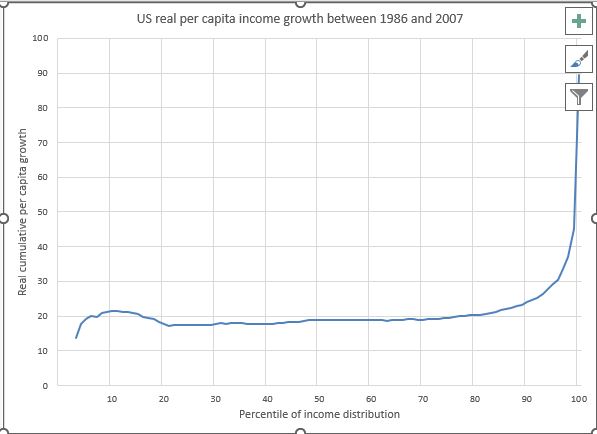
Growth as such without taking into account who benefits from it is neither ethically acceptable, nor politically sustainable. That’s where the second plank comes in: economic equality. Growth cannot be blind, nor can it be such that most of it, like in the US in the period 1986-2007 (see the graph below) is collected by the rich. It must be pro-poor which means that incomes of the lower groups should rise, in percentage terms, at least as much as incomes of the richer groups. How to achieve this? Not only through direct taxation or indirect taxation of activities and goods consumed by the rich (the latter is an area which is, in my opinion, under-utilized). It can be achieved through high inheritance taxes which would ensure reasonably equal starting position regardless of parental wealth, by almost free or fully free public education and health, and by special support for the young, around the time of their first jobs. The young are now in the developed Western societies as a group in need of as much support as what people who are currently old managed to politically achieve in the 1960s and 1970s. 


Reduced income and wealth inequalities are both an objective in themselves and a tool for achieving something else: relative political equality. That equality is undermined in today’s advanced societies not, as it is claimed, by an ill-defined “populism”, but by a very opposite danger: that of plutocracy. The fact that rich people fund the campaigns, pay politicians (which is just a more subtle form of bribery), and control most of the mainstream media, makes mockery of political  equality.

The paleo-left should, in my view, eschew such terms that the neoliberal discourse has captured and made meaningless, like democracy. We have to acknowledge that the term “democracy” has been hijacked by the neoliberal plutocracy in the same way that the term “people” was hijacked by the communist authorities in Eastern Europe. Both terms are used to cover up the reality. 

Instead the paleo-left should focus on something much more real and measurable: approximate political equality. The latter implies public financing of political campaigns, limits (or bans) on rich people’s control of the mass media (no “Washington Post” ownership for Jeff Bezos), and equal participation in the electoral process which in turn means making participation in the elections easier for hard-working people. Current elections in the US are intentionally scheduled for a working day, and it is neither a surprise, not an advertisement for “democracy”, that even in the most important elections one-half of the electorate simply does not participate.

The paleo-left also recognizes that the freedoms of speech and association are largely meaningless so long as approximate political equality does not exist. Individuals can spend hours and days complaining on Twitter, but it will carry zero political influence as compared to the well-paid and organized think-tanks and other institutions whose objective is to directly affect policy. It is in that area that a vague use of the term “democracy” in reality conceals vast inequality in access to political power.

The last plank is internationalism. This is, of course, an old left-wing slogan, and it should not be seen as something that is just tacked on to the rest of the domestic agenda. It is a constituent part of the overall agenda. The paleo-left accepts that different countries and cultures may have different ways in which they choose their governments or in which they define political legitimacy. The paleo-left is not ideologically hegemonic. The paleo-left might believe (and should believe) that its own approach is the best, and is right to argue for it, but the argument must be always at the level of ideas, must avoid gross interferences in the internal affairs of other countries, and must obviously never use violence. The paleo-left must get rid of the noxious idea of a “liberal world order” which is either meaningless (as it changes depending on what is politically convenient for its proponents) or is an outright invitation to wage wars. It replaces it by the respect of international law as defined by the United Nations, and by other institutions that are inclusive of all peoples. The paleo-left proselytism is made only by non-violent means, and with respect for other cultures and states, and no coercion of any kind.  

There are many other issues that cannot be directly covered by these simple rules. They concern migration, gender and racial equality, relations between the church and state etc. but they can be, I believe, relatively easily deduced from these four general principles.